The Canyons of the Val di Non are among the most fascinating natural attractions in Trentino, offering a unique journey through rocky gorges, ancient sanctuaries, hermitages, and medieval castles nestled in pristine nature. This extraordinary landscape was shaped over thousands of years by the powerful action of water and ice, creating one of the most distinctive environments in the Dolomites region.
The Val di Non is characterized by terraced hills, undulating plateaus, and deep ravines carved by the River Noce and its many tributaries. During the historic glaciations of the Quaternary period, the valley was completely covered by ice. As the glaciers retreated around 15,000 years ago, they left behind a network of streams that continued to carve the limestone gorges, smoothing the rock and filling the slopes with debris.
All these ancient channels converge today in the area occupied by the Lake Santa Giustina Reservoir, a vast hydroelectric basin of 4 km² containing 172 million cubic meters of water. When the water level drops, the lake reveals its dramatic “tentacle‑shaped” canyon bed, with narrow ravines branching northward like the roots of a giant tree.
This geological amphitheatre, known as the Anaunia Basin, is marked by spectacular gorges, ravines, and canyons that contrast sharply with the gentle rolling slopes of the surrounding orchards. Among the most impressive formations are the Rocchetta Gorge, the San Romedio Canyon, the Rio Novella Gorges, the Doss Busen Ravine, the Mostizzolo Canyon, the Fondo Canyon, the Castelfondo Ravine, and the Diavola Gully near Ruffré.
The Rio Sass Canyon – A Journey into the Heart of the Earth
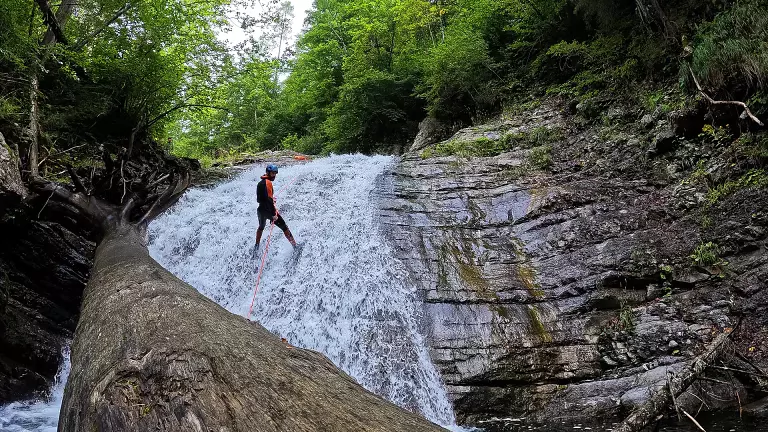
The Fondo Canyon—also known as the Rio Sass Canyon—is a deep natural rift that divides the village of Fondo in two. Since 2001, visitors can explore it safely thanks to a system of walkways and staircases, discovering whirling waters, waterfalls, giant’s kettles, fossils, stalactites, and stalagmites.
The route features:
- 145 meters of elevation difference
- 348 steps
- narrow passages as tight as 25 cm
- vertical drops up to 45–50 meters
Light and shadow play across the rock walls, while colonies of red and green algae create striking color contrasts.
The Santa Giustina Dam and the Lost Bridges
From the top of the Santa Giustina Dam (152.5 m), visitors enjoy a breathtaking view of the largest hydroelectric reservoir in Trentino. When the dam was built between 1943 and 1950, the rising waters submerged ancient roads and bridges, including the medieval Ponte Alto and the legendary Ponte della Mula, linked to the tale of the Baron of Castel Cles and his heroic mule.
The two sides of the Noce River are now connected by the impressive Mostizzolo Bridge, a 19th‑century engineering masterpiece suspended above a deep gorge.
Sanctuaries, Hermitages and Castles
Exploring the canyons of the Val di Non also means discovering centuries of history and spirituality. Along the trails, hikers encounter:
- the mysterious Diavola Gully, associated with ancient legends
- the Hermitage of San Biagio, perched above the dramatic Rio Novella Gorge
- the fairy‑tale Castelfondo Castle, once protected by walls, a moat, and a drawbridge
- the ruins of Castel Cagnò (Castelaz), guarding ancient trade routes
- the San Martino Sanctuary in Vervò, standing on a rocky promontory
These sites preserve stories of saints, nobles, battles, and folklore, enriching every hike with cultural depth.