 © Depositphotos
 © Mario Vidor
 © Shutterstock
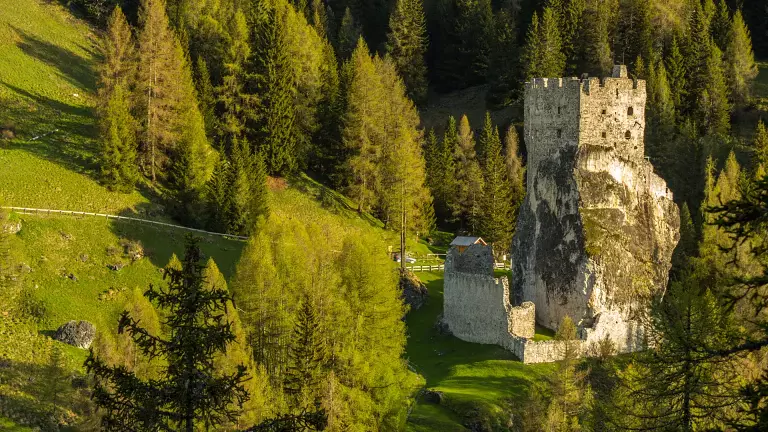
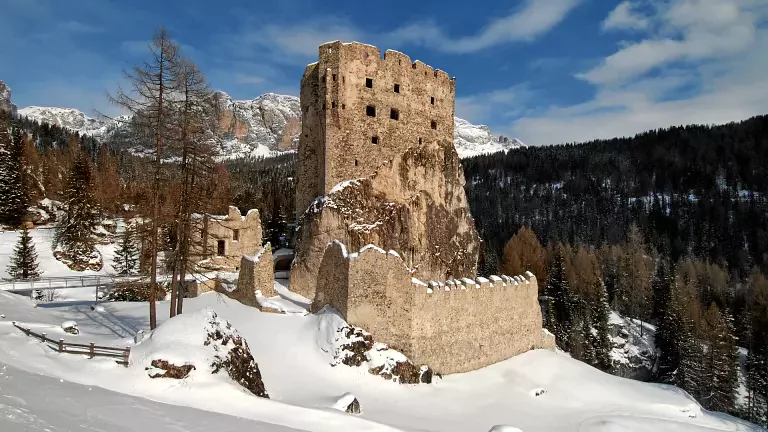
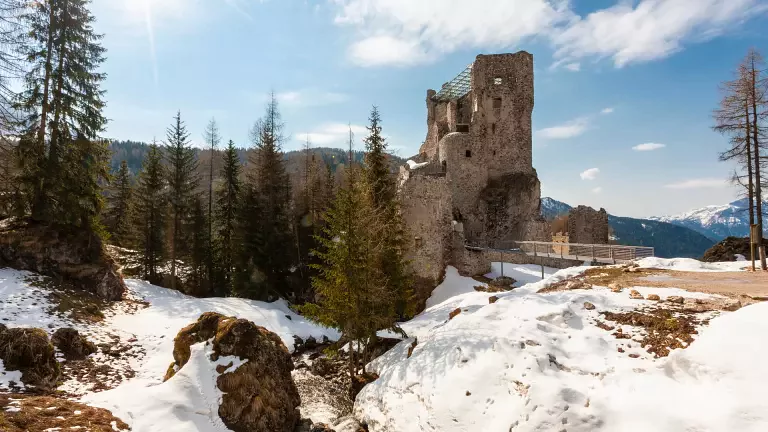
Andraz Castle stands just below the Falzarego Pass, in Livinallongo del Col di Lana, in a strategic position controlling the routes that, as early as the Middle Ages, connected the territories of Belluno—and later those of the Venetian Republic—with the areas north of Caprile belonging to the Bishop of Bressanone. Linked to other fortresses, Andraz Castle formed part of an organised system for monitoring traffic between Agordino and Val Pusteria. Today it houses the Andraz Museum.
The history of Andraz Castle
Andraz Castle was built using local stone on a gigantic rocky spur that broke away from the Settsass Dolomite group during the Ice Age. These unique features give the fortress an extraordinary harmony with the surrounding natural environment.
From the 11th to the 15th century, the castle remained under the control of vassals serving the Bishop-Counts. After 1416 it was taken over directly by the Bishopric, which made it an important military stronghold throughout the Middle Ages. From 1454 to 1460, Cardinal Nicholas of Cusa (Nicolò Cusano), philosopher of the “coincidence of opposites”, found refuge here.
Located close to an area rich in natural resources—especially timber and minerals—the castle began to lose importance after mining activities ceased in 1753 and following the secularisation of the ecclesiastical principalities.
In 1802 it passed to Bavaria, and in 1808 it was sold to a private owner who used it to obtain building materials. Its deterioration continued with the removal of furnishings and the dismantling of the roof for firewood.
During World War I it was bombed by Austrian forces, as it had become an encampment for Italian troops. After the war it was used as a stone quarry for the reconstruction of the nearby village of Castello.
Since 1985 Andraz Castle has been the property of the Veneto Region, which has initiated a restoration project to preserve what remains of the original structure.
The Andraz Castle Museum
The Andraz Castle Museum, inaugurated in June 2012, was created to promote knowledge of the castle and the surrounding Dolomite landscape. It illustrates the historical events of Andraz and its transformations over time due to fires and wartime damage. One section is entirely dedicated to Cardinal Nicholas of Cusa, who lived here from 1454 to 1460. The museum also displays written and visual evidence of ironworking, along with archaeological finds discovered inside the fortress.
Andraz Castle Ticket Prices
Full price: € 7.00
Reduced € 4.00: for young people aged 7–19 and university students (with valid student ID), groups without guided tour*
Reduced € 6.00: for visitors over 65
Reduced school groups € 3.00: for school classes of all grades (N.B. ticket valid for entrance only, guided tours and workshops excluded)
Free admission: entitled visitors and their companions, children up to 5.99 years
Audio guide rental: € 1.00
*+ € 2.00 guided tour. Extra charge applies only to the full and over 65 reduced ticket; group rate varies depending on the number of participants
Supporter fee: + € 5.00 on the admission ticket; includes a complimentary Andraz Museum Guidebook
Family ticket: - € 2.00 on the total admission price (also valid for single parent families).
Opening hours of Andraz Castle
In JUNE, JULY, AUGUST and SEPTEMBER: 10:00–12:30 and 14:30–18:00.
Every Sunday in July and August: continuous opening hours 10:00–18:00.
OCTOBER: 10:00–12:30 and 14:00–17:00.
For further information:
Andraz Castle
loc. Castle | 32020 Livinallongo del Col di Lana (BL)
Tel. (+39) 334 66 80