 © Federico Modica
 © Federica Cerri
 © Federica Cerri
In the heart of Paneveggio – Pale di San Martino Nature Park, between Val di Fiemme and the mountains of Trentino, lies one of the Dolomites’ best-known forests: the Violin Forest. Its name is linked to resonance spruce trees, whose wood is particularly well suited to making musical instruments.
For centuries, these forests have been associated with the tradition of Italian violin making. The finest trunks can be used to produce important components of violins, violas, cellos and other string instruments. This connection between nature, forest management and music has made the Violin Forest one of the most distinctive attractions to visit in Val di Fiemme.
Local tradition also connects these spruce trees with Antonio Stradivari, the famous Cremonese violin maker who, according to stories passed down through the generations, is said to have visited the forests of the valley in search of the finest wood for his instruments.
Where is the Violin Forest?
The Violin Forest is mainly located around Paneveggio, within the nature park, and is closely connected to the forests of Val Venegia and the territory historically managed by the Magnifica Comunità di Fiemme.
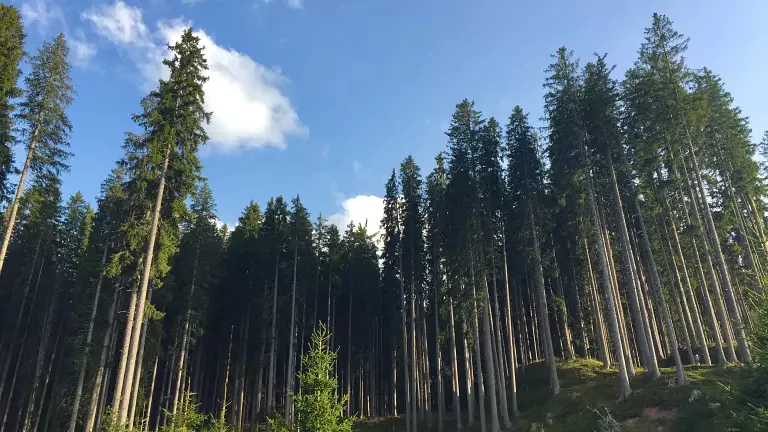
The landscape is dominated by Norway spruce, together with other species typical of the Alpine environment. Here, the forest is more than a place to walk through: it represents the result of a centuries-old relationship between local communities, forestry and the natural environment.
The area's particular climatic and environmental conditions favour the growth of spruce trees with straight trunks and wood featuring characteristics sought after by violin makers. However, not every tree can become raw material for a musical instrument: specific requirements concerning the structure and regularity of the growth rings must be met.
Why are the spruce trees of the Violin Forest special?
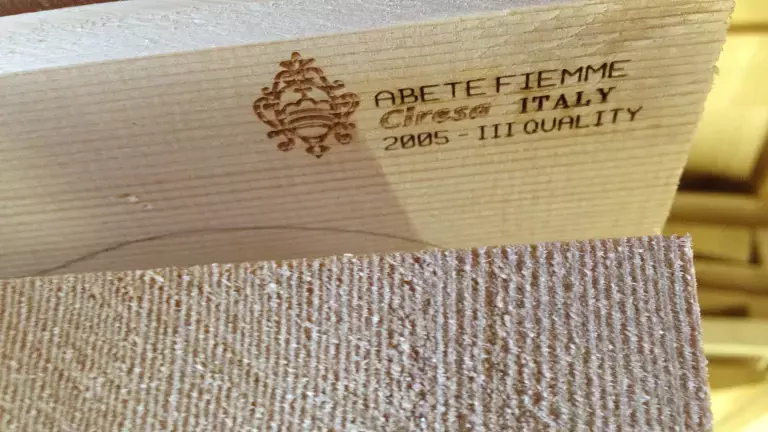
The wood of resonance spruce is highly valued in violin making for its ability to transmit vibrations. Slow tree growth, regular growth rings and local environmental conditions all contribute to producing a material that is particularly suitable for making soundboards.
Tree selection is therefore extremely rigorous. The trunk must have precise characteristics and an internal structure suitable for processing. In such a large forest, only a limited number of trees have the qualities required by violin makers.
This careful selection makes a walk through the forest even more fascinating: behind every spruce lies a story that can ultimately reach the workshops of violin makers and concert halls around the world.
What to see in the Violin Forest
The Paneveggio area offers several points of interest where visitors can discover the connection between forests, wildlife and musical tradition.
Marciò Trail
The Marciò Trail, near the Paneveggio Visitor Centre, is one of the most interesting routes for discovering the environment of the Violin Forest.
The trail passes through the woodland alongside the Travignolo stream, allowing visitors to observe the trees, the riverside environment and aspects of forest management up close. Information panels along the route provide insights into the area's nature and history.
Highlights include the suspension bridge and the covered wooden bridge, which make the walk particularly enjoyable for families with children.
It is an ideal trail for understanding why the wood of the Paneveggio spruce trees has such an important connection with music.
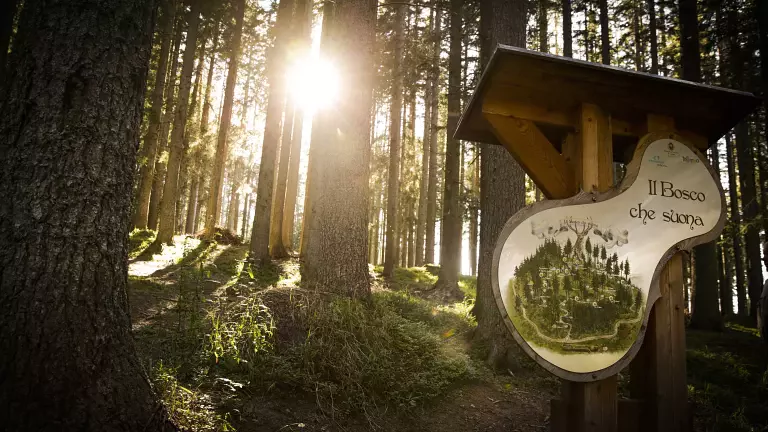
The Singing Forest
Another experience linked to the musical tradition of Val di Fiemme is the Singing Forest, located in the Predazzo area.
Here, the relationship between trees and music is explored through a themed trail immersed in the forest. The experience combines the natural landscape with music, creating an itinerary that differs from a traditional Dolomite hike.
The trail winds through spruce and larch trees and highlights the acoustic dimension of the forest. It is an especially atmospheric place for discovering the cultural side of Val di Fiemme beyond its mountains and hiking trails.
Paneveggio Deer Wildlife Area
Near the Paneveggio Visitor Centre you will also find the deer wildlife area, where these animals can be observed in a specially designated environment.
The visit is particularly appealing to families and offers an opportunity to learn more about one of the most representative species of Alpine wildlife. In autumn, the rutting season makes the behaviour of the deer especially fascinating.
The wildlife area adds another dimension to a visit to the Violin Forest: these woodlands are not only a source of timber, but also an important natural habitat.
Val Venegia: nature and the Dolomite landscape
Val Venegia is one of the most spectacular valleys in the Paneveggio area and is well worth combining with a visit to the Violin Forest.
Alpine meadows, streams, forests and impressive views of the Pale di San Martino create a quintessential Dolomite landscape. The valley can be explored on walks of varying lengths and difficulty.
Here too, the forest tells the story of the area's relationship between people and nature. Following the extreme weather events of recent years, some areas still show the effects of the 2018 Vaia storm, providing an opportunity to reflect on the vulnerability of Alpine forest ecosystems and their ability to regenerate.
The Violin Forest after Storm Vaia
Storm Vaia profoundly changed many forests in Trentino, including parts of the area associated with the Violin Forest.
The wind damage left large areas without trees and transformed the landscape. Subsequent forest management required recovery and safety measures, as well as interventions to support forest regeneration.
Visiting the area today therefore means seeing not only a forest famous for its resonance spruce trees, but also an environment undergoing change. Mature trees coexist with areas experiencing natural regeneration and new generations of trees.
When to visit the Violin Forest
The forest is a natural environment that can be explored in different seasons, choosing trails according to weather and ground conditions.
Summer is ideal for walking through the forest and combining a visit with Val Venegia and other attractions in Paneveggio – Pale di San Martino Nature Park.
Autumn brings particularly intense colours and offers the chance to experience the deer rutting season.
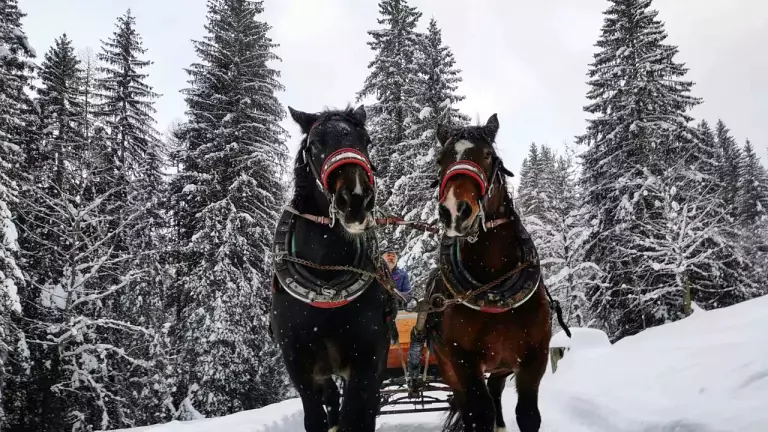
In winter, snow and low temperatures can affect trail conditions, so it is important to check the accessibility of routes and any restrictions before setting out.
Spring, meanwhile, offers the opportunity to watch the Alpine environment gradually awaken, although snow and ice may still be present at higher elevations.
Practical information for visiting
Opening hours
The Violin Forest is an open-air natural environment and does not have a single opening schedule like a museum. Access to the trails may nevertheless be affected by the season, weather, snow, forestry work or safety requirements.
The Paneveggio Visitor Centre and the deer wildlife area have their own opening hours, which may change throughout the year.
Before planning your visit, it is advisable to check the park's latest official information.
Tickets
Access to the natural trails of the Violin Forest does not normally require a single entrance ticket to the forest itself.
Some facilities, guided tours, educational activities or services at the Visitor Centre may charge a fee. Prices and access arrangements may vary depending on the season and the activity.
Where to park
Parking areas are available near the main points of interest and the Paneveggio Visitor Centre.
For the Marciò Trail, the most convenient option is the parking area near the Paneveggio Visitor Centre. For other routes, always use authorised parking spaces and follow local signs.
During the busiest periods, particularly in summer, arriving early in the morning can make parking easier.
How to get to the Violin Forest
The Violin Forest is located in Val di Fiemme, in Trentino, with Paneveggio being the best-known access point.
By car, coming from the Ora/Egna area, travel up Val di Fiemme through the main towns of the valley and continue towards Predazzo. From there, follow the signs for Paneveggio and Passo Rolle.
The Paneveggio Visitor Centre is one of the main reference points for visitors who want to begin their visit and find out more about the available trails.
Those travelling by public transport can check seasonal connections between the towns of Val di Fiemme and the Paneveggio area, bearing in mind that services and timetables vary throughout the year.