 © DOLOMITES Val Gardena
The tradition of Nativity scenes in the Dolomites has its roots in Alpine culture, where Christmas has always been associated with community, craftsmanship and spirituality. Throughout the valleys of Trentino-South Tyrol, this tradition remains deeply rooted in the local identity and can be experienced through wooden Nativity scenes, themed trails, living Nativity scenes and villages that transform into open-air museums during the winter months.
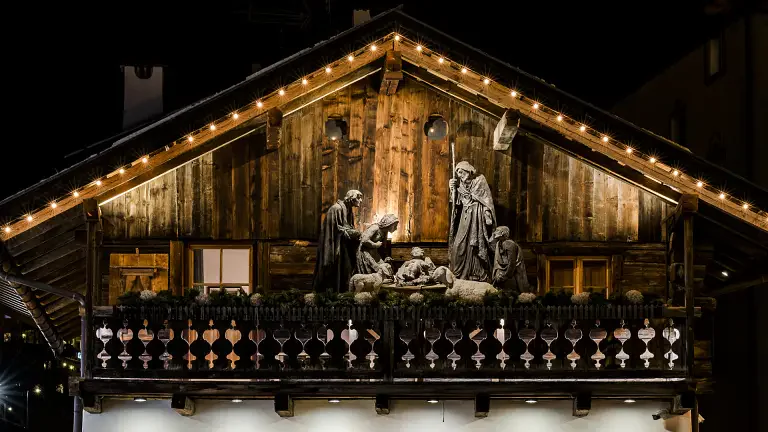
The Dolomite Nativity scene is much more than a Christmas decoration: it is an expression of the art and culture of the mountains. Its strong connection with wood craftsmanship can be seen in hand-carved figures, rural settings and recreations of traditional Alpine occupations. Shepherds, farmers, craftsmen, animals and characters from the Nativity story therefore tell not only the story of Christmas, but also of everyday life in mountain communities in the past.
The most beautiful Nativity scenes in Trentino
Among the best-known destinations for Nativity scenes in Trentino, Ossana in Val di Sole holds a special place. The village is famous for its exhibition of one thousand Nativity scenes, spread throughout streets, courtyards and characteristic corners of the village, all the way to Castello San Michele. Walking through the exhibition allows visitors to discover Nativity scenes created using different techniques, materials and styles, all surrounded by the enchanting Christmas atmosphere of the Dolomites.
Tesero, in Val di Fiemme, is another unmissable destination for lovers of traditional Nativity scenes. Its distributed Nativity scenes transform the historic centre into a trail dedicated to craftsmanship and the Nativity story. Small wooden huts, decorated alleyways and carefully crafted scenes recreate the authentic atmosphere of Alpine villages from the past.
In Faedo, in the Piana Rotaliana, Christmas comes to life through a fascinating living Nativity scene. Life-size figures, period costumes and the traditional “Canta della Stella”, a star-singing tradition that takes place in the village at the beginning of January, combine popular traditions and spirituality in a unique experience.
In Val di Fiemme, Varena also offers a distinctive Christmas trail. Visitors can enter the huts and admire reconstructions of traditional rural scenes at close range, all created with great attention to detail. It is an ideal experience for those who want to experience the Nativity tradition from an immersive perspective, surrounded by wood, natural materials and typical mountain settings.
For an even closer connection with nature, the Nativity scenes in the Zanolin woods, near Ziano di Fiemme, lead visitors along a trail immersed in the Alpine landscape. The installations, made from wood, bark and other natural materials, blend harmoniously into the forest and create an especially atmospheric experience when the landscape is covered in snow.
Another destination worth adding to any itinerary of Nativity scenes in Trentino is Nomi. Between December and January, the village becomes a true village of monumental Nativity scenes. Large handcrafted works are displayed in the different neighbourhoods, parks and along the village streets, creating a fascinating Christmas trail. One of the highlights is the historic granary in the heart of the village, which hosts some of the largest and most impressive Nativity scenes every year.
The most beautiful Nativity scenes in South Tyrol
In South Tyrol, the Nativity tradition is closely linked to the centuries-old school of Val Gardena woodcarvers, internationally renowned for their artistic woodworking skills.
In Santa Cristina in Val Gardena, visitors can see what is presented as the largest wooden Nativity scene in the world. The monumental work was started in 1988 and has been expanded over the years with new hand-carved figures. The Holy Family, the Three Wise Men, shepherds and animals impress visitors with their size and extraordinary level of detail, offering a remarkable example of the region’s woodcarving tradition.
Those wishing to discover more about the history of Nativity scenes in South Tyrol can visit several important museums dedicated to this art form.
The Heide Nativity Museum in Val Gardena houses a valuable collection of Italian and Austrian Nativity scenes, including numerous works influenced by the traditional woodcarving style of the valley.
In Luttach, in the Ahrntal Valley, the Maranatha Nativity Museum offers a fascinating journey through historic, modern and mechanical Nativity scenes. Monumental settings and activities focused on craftsmanship allow visitors to discover the techniques and traditions behind Alpine Nativity scene making.
In Bressanone, the Hofburg houses one of the most important Nativity scene collections in the world. On the ground floor, visitors can admire the famous annual Nativity scene, which includes around 5,000 figures. It was created for Prince-Bishop Karl Franz Lodron for a room in his apartment in the episcopal palace and is one of the most valuable pieces in the collection. The exhibition also includes Nativity scenes from Bressanone, Tyrol, Naples and Sicily, offering an opportunity to compare very different artistic and cultural traditions.
Discovering Nativity scenes in the Dolomites: a journey through art and tradition
The Nativity scenes of Trentino-South Tyrol are a living cultural heritage that tells the story of the region through art, craftsmanship and local traditions. From Nativity trails in historic villages to monumental wooden sculptures, forest paths and specialised museums, each destination offers a different way to experience Christmas in the Dolomites.
Walking through illuminated villages, squares, narrow streets, courtyards and snow-covered forests means rediscovering Christmas in its most authentic form. It is a journey through natural materials, traditional craftsmanship and stories passed down from one generation to the next.
For anyone looking for things to see in the Dolomites at Christmas, the Nativity scenes are an unmissable experience. They offer the opportunity to discover Alpine traditions, visit some of the most beautiful villages in Trentino and South Tyrol, and immerse yourself in the magical atmosphere of winter in the mountains.