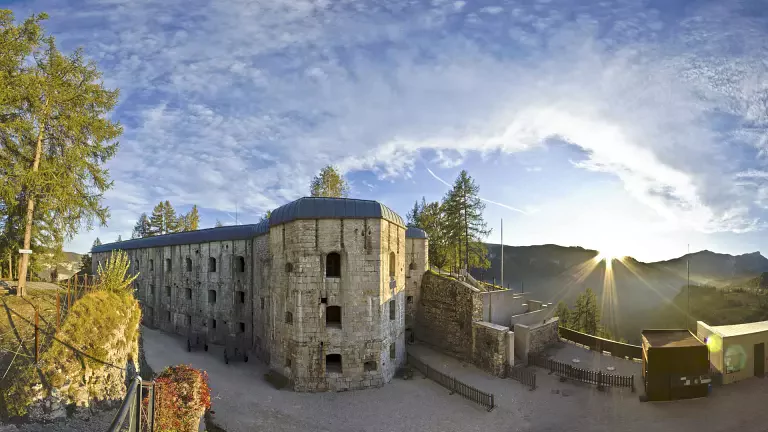
 © APT Folgaria, Lavarone, Luserna
The Forte Belvedere in Lavarone – Werk Gschwent is one of the best-preserved Austro-Hungarian fortifications on the Alpe Cimbra and today hosts an interesting museum dedicated to the First World War.
Built between 1908 and 1912 on a rocky spur above Óseli, the fort overlooks the Val d'Astico and tells the story of the Great War through the original rooms of the fortification, artifacts, reconstructions and multimedia installations.
Why visit Forte Belvedere
The visit allows you to enter the heart of a fortress built directly into the mountain and designed to withstand bombing.
Inside you can see:
- the casemates and original rooms of the fort;
- spaces dedicated to the daily life of soldiers;
- military and defensive structures;
- the First World War Museum;
- reconstructions and multimedia installations about life in war;
- a reconstruction of a trench.
The museum path develops over three floors and guides the visitor from the history of the fort and the community of Lavarone to mountain warfare, the life of soldiers and the major themes of the First World War.
The Museum of the Great War
The Forte Belvedere museum explores the history of the Plateaus during the First World War.
The ground floor tells the story of the birth of the fortification system and the history of Lavarone. The first floor is dedicated to military events, the White War and war medicine. The second floor addresses more general themes, such as trench warfare, propaganda, industrial war and the daily life of soldiers.
Interactive and multimedia installations make the visit particularly engaging and help you understand what life was like inside the fort during the conflict.
The history of Forte Belvedere in brief
Forte Belvedere was part of the Austro-Hungarian defensive system of the Plateaus and was tasked with controlling the territory towards Val d'Astico.
The structure was protected by over 2.5 meters of concrete and a series of steel reinforcements. It was also designed to function autonomously thanks to aqueduct, water purifier, power plant, warehouses, first aid and communication systems.
During the First World War it was hit by bombardments, but suffered less devastating damage compared to other fortifications in the area.
After dismantling began in 1940, the fort was progressively recovered until it was transformed into a museum.
How to get to Forte Belvedere
Forte Belvedere in Lavarone is accessible on foot, except for people with disabilities with the appropriate permit.
At the beginning of the access road there are 10 parking spaces. Other parking for cars and buses can be found along the main road towards Óseli.
Attention: access for animals is not permitted for safety reasons related to the structure and internal spaces.
Opening hours and prices of Forte Belvedere
Full price: 8€
Reduced (Adults over 65, teenagers between 7 and 17, organized groups over 10 paying participants, armed forces, partner groups, UniTn students, ANA ordinary members): 6€
Family ticket (Two parents plus one child under 18, additional minors free): 18€
Free: Children under 7, Guest Card holders, disabled visitors, group leaders, teachers and supervisors for organized guided visits
Entrance + guided tour
Full price: 10€
Reduced (Adults over 65, teenagers between 7 and 17, organized groups over 10 paying participants, armed forces, partner groups, UniTn students, ANA ordinary members): 8€
Schools, Educational institutions (Reduced entrance valid only for groups of students under 18 during school period. Teachers, disabled visitors and supervisors free.): 4€
Family (Two parents plus one child under 18, additional minors free): 25€
Trentino Guest Card (Single person rate): 3€
Opening hours
September: Every day from 1st to 14th; every Saturday and Sunday | From 10:00 to 18:00
October: Every Saturday and Sunday | From 10:00 to 18:00
November: 1st and 2nd | 10:00 – 17:00
December: From 6th to 8th and from 27th to 31st December | 10:00 – 16:00