 © Azienda per il Turismo Rovereto e Vallagarina
 © Azienda per il Turismo Rovereto e Vallagarina
 © Azienda per il Turismo Rovereto e Vallagarina
In the heart of Monte Baldo, Brentonico offers an interesting journey through nature, botany and paleontology. It is an ideal destination for those who want to discover the territory also through its oldest traces: from fossils of marine organisms that lived millions of years ago to the particular plant species that characterize Baldo.
Making the experience even more interesting are the Brentonico Botanical Garden and the Monte Baldo Fossil Museum, both housed in the Palazzo Eccheli Baisi area.
The Brentonico Botanical Garden: the flora of Monte Baldo
The Brentonico Botanical Garden extends for over 3,500 square meters in front of Palazzo Eccheli Baisi and allows you to get to know up close the extraordinary botanical variety of Monte Baldo.
The garden is divided into two main areas. The first is a Renaissance garden, organized on three levels with geometric flower beds where lavenders, medicinal plants and some of the most characteristic species of the territory are cultivated.
The collections are organized by themes and include, among others, endemic species, food plants, poisonous species and ruderal plants.
The second area instead reproduces some of the natural environments of Monte Baldo. Walking through the different sections it is possible to observe spontaneous species associated with habitats such as thermophilic rocky grassland, nitrogen-rich pasture, wetland area, subalpine scrub and fern grove.
For visitors it is a simple and pleasant way to understand why Monte Baldo is known for its particular botanical richness.
The Monte Baldo Fossil Museum
In the ancient vaults of Palazzo Eccheli Baisi is the Monte Baldo Fossil Museum, which preserves over 1,000 specimens from the Northern Monte Baldo area.
The collection tells a much older story than that of the mountains we see today. The fossils document organisms that lived in marine environments between about 150 and 180 million years ago, in the period following the Triassic.
Among the finds are fossils belonging to different groups of organisms, from Protozoans to Crustaceans. Particularly interesting is the collection of Gastropods from the Sorne deposit, where 134 species have been classified.
Visiting the museum therefore means discovering a very different Monte Baldo from the present one: millions of years ago this area was part of a marine environment in which numerous organisms lived, whose traces have been preserved in the rocks.
The dinosaurs at Lavini di Marco: another must-see stop
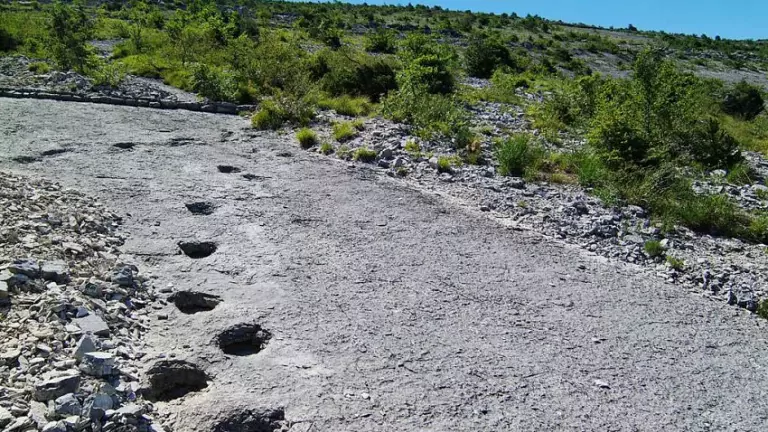
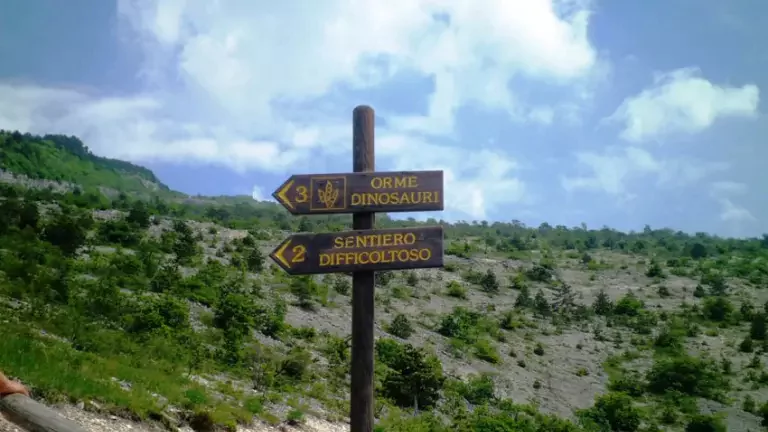
The journey into the prehistory of the territory can continue towards Rovereto, to the Lavini di Marco, one of the most important places in Trentino for dinosaur footprints.
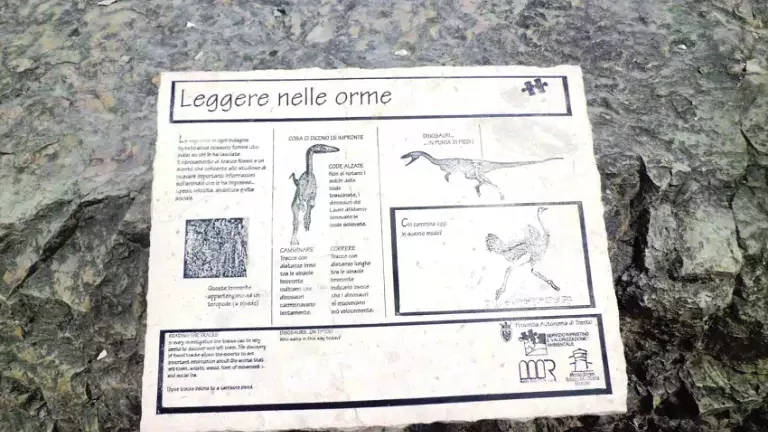
Here, on the rocky surfaces, the footprints left about 200 million years ago are still visible, during the Jurassic, by large reptiles that crossed ancient coastal environments.
The fossil trails allow you to recognize the tracks of dinosaurs belonging to different groups, including bipedal Ornithischians and Theropods. The footprints were preserved thanks to a long geological process: the animals' steps left their mark on muddy sediments that, over millions of years, transformed into rock.
To further explore the discovery of the trails and the history of the territory's dinosaurs, you can visit the Rovereto Museum of Sciences and Archaeology, where paleontology plays an important role in the collections and activities dedicated to the public.