 © alex1965 | Pixabay
The Hofburg of Brixen, also known as the Bishop’s Palace, is one of the most fascinating historic and artistic complexes in South Tyrol. Located in the heart of the old town, it preserves centuries of ecclesiastical and civic history and today hosts the prestigious Diocesan Museum and the Diocesan Archives.
From the Residence of the Prince-Bishops to the Diocesan Museum
From the mid-13th century until 1973, the Hofburg served as the residence of the prince-bishops—first as the seat of their temporal and spiritual power, and later, after the secularisation of 1803, as the home of the diocesan bishop.
In 1973, after the bishop’s seat was transferred to Bolzano, the palace took on a new role and officially became the home of the Diocesan Museum, originally founded in 1901 to protect and preserve valuable sacred artworks at risk of being lost.
Over the 20th century, the collection grew rapidly, requiring several relocations and expansions until the current exhibition layout was established within the palace’s historic halls.
The Diocesan Museum
The Diocesan Museum of the Hofburg is divided into several thematic sections and houses an artistic heritage ranging from the Middle Ages to the 20th century.
Visitors can admire sacred sculptures from the 13th century, as well as panels and paintings by artists such as Leonardo da Bressanone, Jörg Lederer, and Lucas Cranach, along with significant examples of Late Gothic and Tyrolean Baroque art.
Some of the most captivating areas of the palace are its historic apartments, richly decorated with stuccoes, frescoes, majolica stoves, and 18th–19th-century furnishings, offering an authentic glimpse into the courtly life of the prince-bishops.
The museum route also includes the renowned Treasure of Brixen Cathedral, one of the most important in the Alpine region. Its most famous piece is the chasuble of Albuin, dating to around the year 1000 and considered one of the oldest and most precious liturgical vestments in Europe.
Nativity Scene Collection
Brixen boasts a centuries-old Nativity scene tradition. The Hofburg houses one of the richest and most artistically diverse collections in the Alps: Nativity scenes from Brixen, Tyrol, Naples, and Sicily, including magnificent compositions created around 1800 by Franz Xaver Nissl and the Probst brothers. A recent expansion has added the valuable private liturgical Nativity scenes of Martin Rainer.
The Renaissance Courtyard: An Architectural Masterpiece
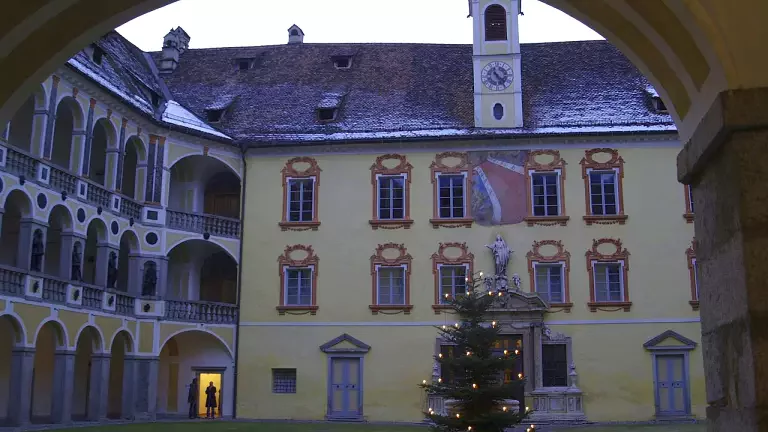
One of the most evocative features of the Hofburg is its large Renaissance courtyard, built in 1595 by court architect Albrecht Lucchese for Cardinal Andrew of Austria. Surrounded by elegant arcades on three levels, it was originally intended to include 44 terracotta statues representing the Habsburg family tree. Although the project remained incomplete, 24 statues are still preserved today, forming one of the most significant sculptural ensembles in Tyrol between the Renaissance and Baroque periods.
Since 2016, the courtyard has been enriched by a striking white marble fountain from Ratschings, created by artist Franz Kehrer.
The Court Church: A Baroque Jewel
The Hofburg also includes the stunning Court Church, a baroque single-nave chapel decorated with frescoes, ornate stuccoes, and an impressive marble high altar. The side frescoes, painted in 1708 by Kaspar Waldmann, depict scenes from the life of Mary.
The Aulic Chancellery
In the east wing lie the original rooms of the Aulic Chancellery, from which the prince-bishops governed their principality with their council. The two rooms—the anteroom and the council hall—have remained largely unchanged since the 18th century and represent a rare example of baroque administrative architecture.
Opening hours
OCTOBER - MAY
daily from 10 a.m. to 5 p.m.
JUNE - SEPTEMBER
daily from 10 a.m. to 6.30 p.m.
CLOSED
Easter Sunday
24th & 25th December
Admission
Prices
13€ - adults
10€ - students, groups of 10 or more people
5€ - children, young people (6-18 years), school classes
Free for children up to 6 years of age
There is no separate admission ticket for the Crib Collection, only a single ticket for the Hofburg at the above-mentioned prices.
How to get to Hofburg - Bishop Palace
By car (from the south):
Brennero motorway A22, exit Chiusa-Val Gardena, continue for about 8 km. towards Bressanone up to Autosilo Bressanone in via Dante (directly on the highway), from there walk towards the center, via Santa Croce, via Sant'Erardo, then turn right towards the Bishop Palace
By car (from the North):
Brennero motorway A22, exit Bressanone-Val Pusteria (Varna), proceed for about 5 km. on the state road in the direction of Bressanone, after the second roundabout possibility to leave the car in the parking lot in via Brennero, then continue on foot towards the cathedral and the Episcopal Palace (10 min.); alternatively: by car to the Autosilo Bressanone in via Dante (directly on the main road), from there walk towards the center, via Santa Croce, via Sant'Erardo, then turn right towards the Bishop Palace (5 min.)
By train:
Line Verona-Brennero, stop Bressanone (all international trains, as well as the IC / EC stop at Bressanone), from there by taxi or walk along Via Stazione, Viale Regensburg, via Bastioni Minori, via Sant'Erardo, then turn right towards the Bishop Palace (10 min.)
For further information
P.zza Palazzo Vescovile 2
I-39042 Bressanone
Tel.: (+39) 0472 830505